Uncategorized

freelance digital marketer
Uncategorized

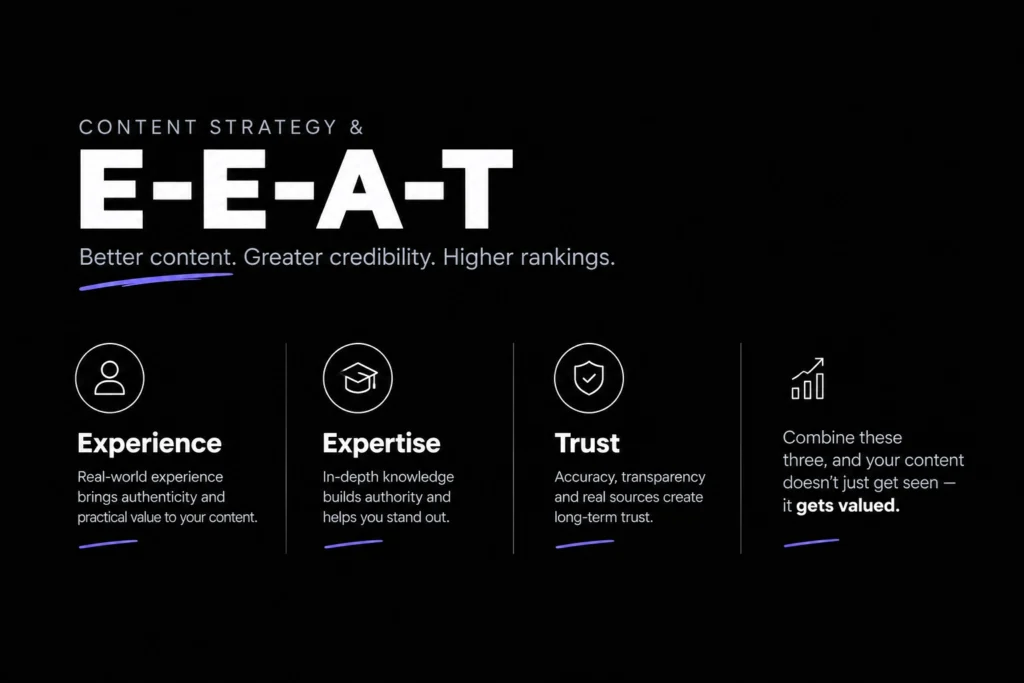
Content Strategy & E-E-A-T: Building Content That Earns Attention, Authority, and Trust

1. The New Era of Content: Beyond Keywords and Clicks freelance digital marketer Over the past few years, content marketing has undergone substantial shift. In the past, a lot of marketers prioritised keywords, search volume, backlinks, and ranks. Nonetheless, contemporary search engines are progressively assessing whether information offers people real value. As a result, companies require a content strategy that goes beyond just posting articles and focusing on well-known search terms. Experience, expertise, authority, and trustworthiness—E-E-A-T—become crucial in this situation. For producing content that exhibits credibility and offers significant value, E-E-A-T offers a helpful framework. freelance digital marketers may develop a long-term strategy for SEO, audience engagement, and brand expansion by fusing a solid content strategy with E-E-A-T principles. 2. What Exactly Is E-E-A-T? Experience, expertise, authority, and trustworthiness are all represented by the acronym E-E-A-T. These ideas are used by Google in its search quality evaluation standards to assist evaluate the calibre of material and the legitimacy of the individuals or organisations who provide it. E-E-A-T provides helpful advice for creating high-quality content, even though it is not a technical SEO checklist nor a single ranking factor. Every component makes a unique contribution. Experience demonstrates a person’s sincere knowledge of the subject. Expertise is a sign of expertise and knowledge. In a certain field, authoritativeness creates recognition. Lastly, trustworthiness gives users the assurance that the organization, website, and information are trustworthy. When combined, these components provide material that feels genuine rather than manufactured for search engines. 3. Experience: Let Real Knowledge Lead the Story Experience adds a human element to content. Experienced content shows what actually happens when someone follows a specific method, as opposed to merely rehashing information found on hundreds of other websites. A freelance digital marketer could talk about the lessons they’ve learnt by managing a social media campaign, optimising a website, researching keywords, or developing an SEO plan. Additionally, case studies, firsthand observations, campaign outcomes, images, examples, and useful suggestions can all be used by marketers to showcase their experience. These components make it clear to readers that the author has engaged with the topic rather than just summarising data from other sources. For example, an expert freelance digital marketer could describe how altering posting timings, content formats, or audience targeting improved campaign results rather than simply that “social media engagement is important.”These specifics enhance the content’s utility, uniqueness, and credibility. 4. Expertise: Turn Knowledge Into Valuable Content The knowledge and abilities displayed through content are referred to as expertise. The foundations of SEO, content marketing, social media marketing, analytics, branding, email marketing, and other pertinent fields should be understood by a skilled digital marketer. Expertise, however, does not entail using a lot of technical terms in an article. Instead, strong expertise appears through accurate explanations, logical recommendations, relevant examples, and clear problem-solving. A knowledgeable marketer should make complex topics easier to understand while maintaining factual accuracy. Additionally, when marketers are always learning and adapting, their skill increases. Due to the ongoing evolution of search algorithms, advertising platforms, consumer behaviour, and artificial intelligence, digital marketing is changing quickly. As a result, marketers should update their knowledge on a regular basis and replace earlier content when it gets out of current. 5. Authoritativeness: Become a Recognized Voice Over time, authority grows. It takes more than just writing dozens of articles in a single day to establish a website as authoritative. Rather, marketers need to continuously prove their expertise and get credibility in their sector. Developing material around a distinct area of expertise is one successful strategy. A digital marketer might concentrate on social media, SEO, content planning, or small-business marketing, for instance. The marketer can progressively build a recognisable professional persona by regularly posting insightful and thoroughly researched content in that field. Additionally, authority can grow through credible mentions, professional profiles, industry contributions, testimonials, collaborations, and quality backlinks. However, marketers should focus on earning recognition rather than manipulating search engines. Genuine authority comes from consistently helping people solve real problems. 6. Trustworthiness: The Foundation of Every Successful Website rustworthiness is arguably the most important component of E-E-A-T because users need confidence before they act on information. A website may demonstrate expertise and authority, but unclear information, misleading claims, or poor transparency can quickly damage credibility. As a result, companies should give precise information, unambiguous contact information, open authorship, and relevant references as needed. Additionally, marketers should refrain from making inflated claims. For instance, claiming that a specific SEO technique can “guarantee the number-one Google ranking” might erode confidence because search rankings are influenced by a variety of shifting variables. Furthermore, reputable references, expert profiles, contributions to the industry, endorsements, partnerships, and high-quality backlinks can all increase authority. However, rather than manipulating search engines, marketers should concentrate on gaining notoriety. Helping people solve actual problems on a regular basis is the foundation of true authority. 7.Content Strategy: From Random Posts to Purposeful Publishing The foundation of a good content strategy is purpose. It might be a waste of time and money to publish content without knowing who the target audience is. Instead, before making a choice, marketers should determine who they want to reach, what issues those individuals face, and what information they require. A strong content strategy usually includes audience research, keyword research, topic planning, content creation, optimization, distribution, and performance measurement. Each piece of content should serve a specific purpose. Some content may attract new visitors, while other content may educate prospects, build trust, generate leads, or support existing customers. Moreover, marketers should create different content formats for different stages of the customer journey. Blog posts can attract search traffic, guides can educate readers, case studies can demonstrate experience, and landing pages can encourage conversions. As a result, content becomes part of a complete marketing system rather than an isolated publishing activity. 8.Creating Content That Search Engines and People Appreciate People should be satisfied with modern content initially. Marketers should never compromise readability and utility just to add keywords, even though SEO is still

digital marketer in india
Uncategorized

I Rebuilt My Portfolio 5 Times — Here’s What Actually Got Me Hired

digital marketer in india 1.Five Versions, One Goal: Getting Hired It seems easy to build a portfolio until you have to do it. I thought that a visually appealing website would inevitably generate chances when I first began building my professional portfolio as a digital marketer. I paid close attention to layouts, graphics, animations, colours, and fonts. But as soon as I published my initial draft, I understood that having a gorgeous portfolio does not guarantee that you would be hired. I rebuilt my portfolio as a result. After that, I rebuilt it three, four, and finally five times. I learned something new about digital marketing, communication, professional presentation, and personal branding from each rendition. More significantly, I found that the most complex-appearing portfolio was not what prospective clients and companies were searching for. They were searching for a portfolio that made it evident what I could accomplish and why my abilities were important. 2.Portfolio Version One: Designing Instead of Communicating My first portfolio focused almost entirely on appearance. I wanted visitors to immediately notice the design, so I used large headings, creative sections, visual effects, and multiple design elements. At the time, I thought adding more features would make my portfolio look more professional. However, I made one major mistake: I concentrated on what the portfolio looked like instead of what it communicated. Visitors could see that I was interested in digital marketing as a result, but they were unable to recognise my abilities right away. My projects lacked meaning, my services were ambiguous, and my introduction was overly vague. Despite having a nice appearance, the website failed to address the most crucial questions: Who am I? What am I able to do? What outcomes am I able to produce? Why should I be picked? I learned a valuable lesson from my initial version: a portfolio is a professional argument, not an art exhibition. Each area should have a purpose and help the visitor comprehend your worth. 3.Portfolio Version Two: Adding Skills Was Not Enough I made the decision to add extra information to the portfolio in my second iteration. I included a thorough skills section that included topics like digital strategy, social media marketing, content marketing, SEO, and website optimisation. I also provided more details about my educational journey and broadened my introduction. I initially thought that adding more abilities would make me seem more competent. But I quickly came to the conclusion that merely stating things like “I understand SEO” or “I can handle social media” doesn’t prove anything. A list of skills can be made by anyone. A portfolio is persuasive when it demonstrates the application of such talents. As a result, I started presenting my skills in a different way. Rather of just enumerating my skills, I began to consider how I could illustrate them using projects, examples, procedures, and quantifiable results. One of the most significant developments in my portfolio journey was this modification. 4.Portfolio Version Three: Turning Projects Into Proof The third iteration became considerably more project-focused. Instead of identifying myself as a digital marketer, I wanted to demonstrate my abilities to visitors. I made sections specifically for each project and described its goals. For instance, I could describe the goal, strategy, execution, tools used, and anticipated result rather of just saying “SEO Project.” With this method, my portfolio changed from a list of assertions to a compilation of supporting data. I also discovered that a project’s context increases its value. A screenshot cannot convey the whole story on its own. A compelling case study examines the issue, suggests a solution, details how it was put into practice, and talks about the outcome. Clearly outlining the procedure shows professional thought, even when a project is made for practice. 5.Portfolio Version Four: The Power of Personal Branding By the fourth version, I understood that my portfolio needed more than projects. It needed a clear identity. A key component of the remodelling was personal branding. I wanted visitors to think of me as a growing professional with particular interests, abilities, and objectives rather than just as someone who had studied digital marketing. I developed a more unified design throughout the website, enhanced my introduction, and polished my visual brand. Moreover, I started paying attention to details such as typography, spacing, colours, headlines, professional photographs, and the overall tone of the website. These elements may appear small individually, but together they influence how visitors perceive a professional. Pretending to be someone you are not, however, is not what personal branding entails. Rather, it entails expressing your true strengths in a straightforward and consistent manner. A portfolio should represent the individual behind it while feeling professional. 6.Portfolio Version Five: Finally, I Focused on the Person Visiting The fifth version represented the biggest change. Instead of asking, “What should I put on my portfolio?” I started asking, “What does the person visiting my portfolio need to know?” Everything was altered by this straightforward query. In order to make it easier for visitors to comprehend who I was, what I did, what services I provided, and where they could view my work, I rearranged my site. I eliminated superfluous details and made key areas more accessible. I also made my calls to action better. A portfolio shouldn’t just give visitors information and leave them unsure of what to do next. The next step should be obvious whether the objective is to examine a case study, initiate a conversation, receive a project request, or establish a professional connection. The fifth version was not necessarily the most visually complicated. Instead, it was the most purposeful. 7.The Feedback That Changed My Approach Learning to take criticism was one of the most important aspects of rebuilding my portfolio. Because it compels you to consider your work from a different angle, feedback can be unsettling. However, it can highlight issues that you might not be aware of. For instance, helpful criticism could point out problems like confusing navigation, a lot of content, poor

digital marketer expert
Uncategorized

Community Management: The Art of Building Conversations, Trust, and Loyal Communities

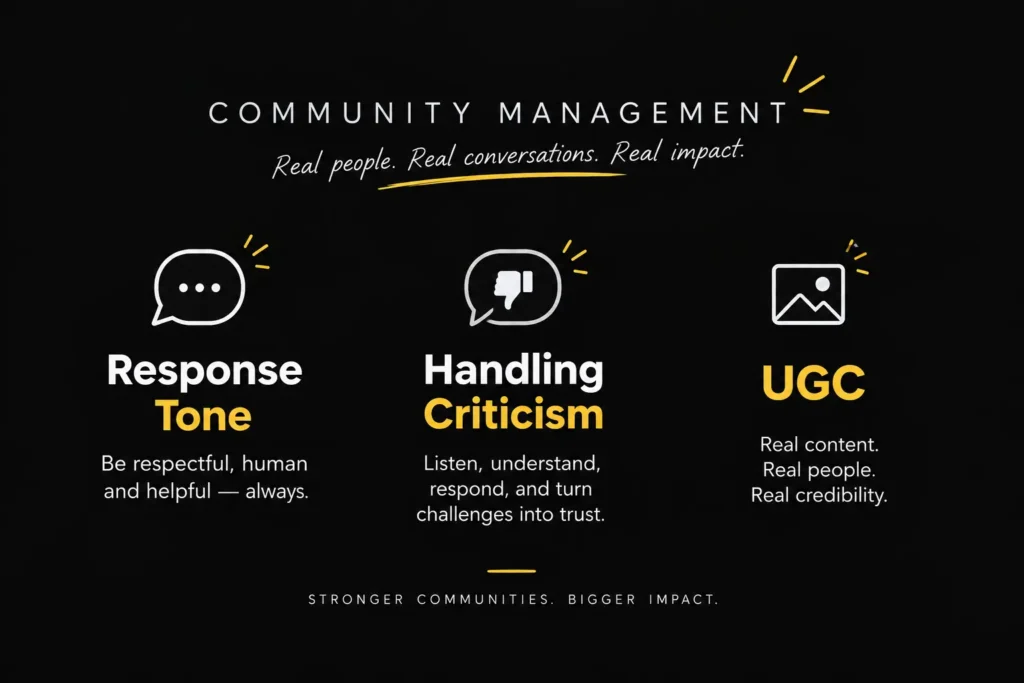
digital marketer expert 1.Community Management: Where Brands Meet Real People In today’s digital landscape, building an audience is no longer enough. Brands must create meaningful relationships with the people who follow, support, and interact with them. Community management plays an important role in this process because it focuses on creating conversations, responding to audiences, addressing concerns, and developing a strong sense of belonging around a brand. Community management requires two-way communication, in contrast to traditional marketing. Brands engage in dialogue and listen to their audiences rather than merely broadcasting promotional messages. As a result, a successful community manager needs to have a thorough understanding of people, communicate effectively, react professionally, and constantly represent the company on digital channels. 2.Why Community Management Matters in Modern Marketing Customers are now active players rather than passive watchers thanks to social media. People may now publish reviews, ask questions, leave comments on blogs, share their thoughts, and produce material about their interactions with brands. As a result, companies need to listen to these discussions instead of concentrating solely on their own material. Effective community management can strengthen customer relationships and improve brand perception. Moreover, quick and thoughtful responses can make customers feel valued. When a brand consistently listens and responds, it can build familiarity and trust. Over time, this relationship can encourage customers to return, recommend the brand, and participate more actively in its community. 3.Response Tone: Every Reply Represents Your Brand Audiences’ perceptions of a brand can be greatly influenced by the tone in which it responds. A professional response should continue to be situation-appropriate, kind, helpful, and unambiguous. Professional communication does not, however, need all responses to sound robotic or unduly formal. Rather, community managers ought to create a distinctive response tone that captures the essence of the brand. A young brand might speak in an approachable and conversational style, yet a financial or professional service might need a more official and precise tone. Responses should be kind and steer clear of pointless disputes regardless of the sector. Community managers should also know the difference between being amiable and being irresponsible. While casual language can foster connections, offensive jokes, sarcasm, or condescending remarks can harm a brand’s reputation. As a result, each response should strike a balance between professionalism and individuality. 4.The First Rule of Community Management: Listen Before You Respond Active listening is one of the most critical abilities in community management. Before answering, a community manager should ascertain the true nature of the user’s problem. A brief remark may occasionally indicate a more serious issue, thus reacting without comprehending the circumstances can lead to further annoyance. For instance, the community manager shouldn’t offer a boilerplate apology right away if a consumer complains about a delayed purchase. Rather, the manager ought to recognise the worry, comprehend the problem, and suggest the proper course of action. Consequently, the response shows genuine attention and becomes more useful. Listening also involves monitoring conversations beyond direct mentions. Customers may discuss a brand in posts, reviews, groups, or other online communities. By monitoring these conversations, marketers can identify recurring questions, emerging concerns, and opportunities to improve the customer experience. 5.Handling Criticism Without Creating Conflict Criticism is unavoidable for almost every brand. Even companies with excellent products and services will eventually receive negative feedback. Therefore, community managers should prepare for criticism instead of reacting emotionally when it appears. Maintaining composure is the first step. An argument shouldn’t always follow from a critical remark. Rather, the community manager should notice the individual’s issue and decide if the complaint needs to be escalated, clarified, or supported by customer service. A careful reaction can frequently turn a challenging encounter into a chance to show professionalism. Additionally, companies shouldn’t remove criticism just because it is unfavourable. Constructive responses can show transparency if a complaint adheres to community standards and reflects a real consumer experience. However, in accordance with well-defined community norms, content that is abusive, threatening, discriminating, or related to spam may need to be moderated. 6.From Negative Comment to Positive Opportunity riticism can provide valuable information. When several customers report the same problem, the community manager can identify a pattern and communicate that feedback to the appropriate internal team. Consequently, community management can contribute to product development, customer service, and overall business improvement. Customers may frequently complain, for example, that a website is hard to use. Instead of handling each comment as a singular grievance, a company can identify the trend and look into the user experience. This method turns community input into useful corporate intelligence. Additionally, public responses can influence people who never participate in the conversation. Potential customers often read comments before making purchasing decisions. Therefore, the way a brand handles criticism can affect not only the original customer but also everyone observing the interaction. 7.UGC: Let Your Community Tell the Brand Story In contemporary community management, user-generated content (UGC) has grown in importance. Photos, videos, reviews, testimonials, articles, comments, and other content produced by clients or community members are all considered user-generated content (UGC). Unlike traditional advertising, UGC often feels more authentic because it comes from real users. Customers can demonstrate how they use a product or explain their personal experience with a service. Consequently, UGC can strengthen credibility and encourage other people to participate. Nonetheless, organisations must to manage user-generated content sensibly. Businesses should get the proper authorisation and give credit where necessary before reusing customer-generated content for marketing reasons. This strategy fosters closer ties between the brand and its community while honouring artists. 8.Building a Community That Wants to Participate A brand’s creation of a social media presence is not enough to build a solid community. People require motivation to engage. As a result, community managers ought to provide chances for members to engage with one another, exchange ideas, share experiences, and ask questions. Participation can be boosted by interactive content. Audiences can be engaged through surveys, questions, challenges, conversations, competitions, behind-the-scenes information, and customer spotlights. Acknowledging significant contributions might also motivate participants to

Scroll to Top