Content Strategy & E-E-A-T: Building Content That Earns Attention, Authority, and Trust
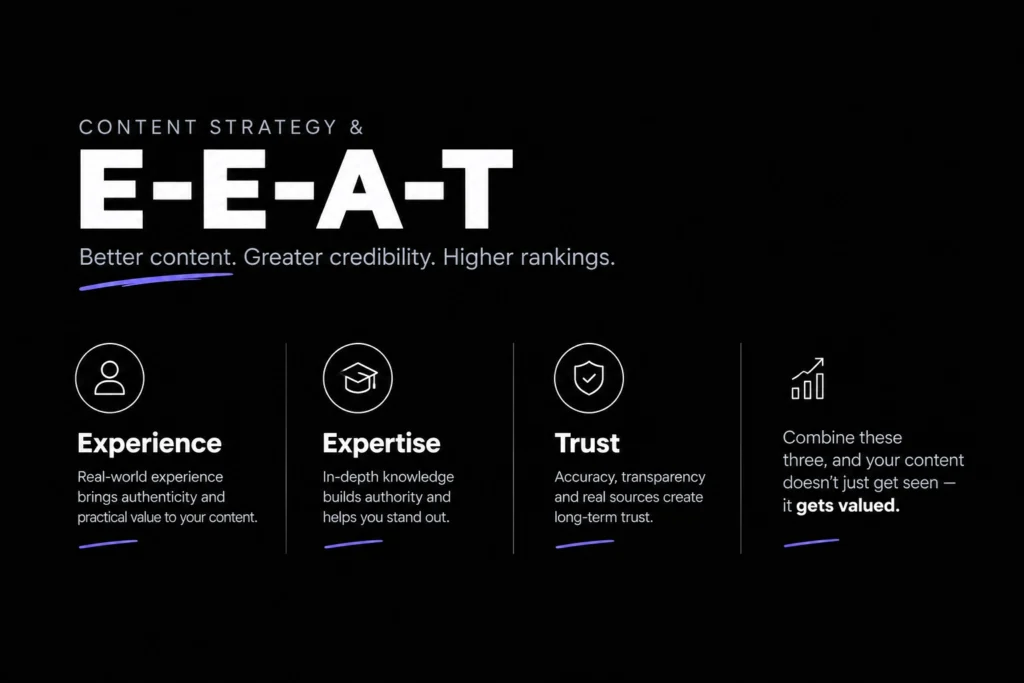
1. The New Era of Content: Beyond Keywords and Clicks freelance digital marketer Over the past few years, content marketing has undergone substantial shift. In the past, a lot of marketers prioritised keywords, search volume, backlinks, and ranks. Nonetheless, contemporary search engines are progressively assessing whether information offers people real value. As a result, companies require a content strategy that goes beyond just posting articles and focusing on well-known search terms. Experience, expertise, authority, and trustworthiness—E-E-A-T—become crucial in this situation. For producing content that exhibits credibility and offers significant value, E-E-A-T offers a helpful framework. freelance digital marketers may develop a long-term strategy for SEO, audience engagement, and brand expansion by fusing a solid content strategy with E-E-A-T principles. 2. What Exactly Is E-E-A-T? Experience, expertise, authority, and trustworthiness are all represented by the acronym E-E-A-T. These ideas are used by Google in its search quality evaluation standards to assist evaluate the calibre of material and the legitimacy of the individuals or organisations who provide it. E-E-A-T provides helpful advice for creating high-quality content, even though it is not a technical SEO checklist nor a single ranking factor. Every component makes a unique contribution. Experience demonstrates a person’s sincere knowledge of the subject. Expertise is a sign of expertise and knowledge. In a certain field, authoritativeness creates recognition. Lastly, trustworthiness gives users the assurance that the organization, website, and information are trustworthy. When combined, these components provide material that feels genuine rather than manufactured for search engines. 3. Experience: Let Real Knowledge Lead the Story Experience adds a human element to content. Experienced content shows what actually happens when someone follows a specific method, as opposed to merely rehashing information found on hundreds of other websites. A freelance digital marketer could talk about the lessons they’ve learnt by managing a social media campaign, optimising a website, researching keywords, or developing an SEO plan. Additionally, case studies, firsthand observations, campaign outcomes, images, examples, and useful suggestions can all be used by marketers to showcase their experience. These components make it clear to readers that the author has engaged with the topic rather than just summarising data from other sources. For example, an expert freelance digital marketer could describe how altering posting timings, content formats, or audience targeting improved campaign results rather than simply that “social media engagement is important.”These specifics enhance the content’s utility, uniqueness, and credibility. 4. Expertise: Turn Knowledge Into Valuable Content The knowledge and abilities displayed through content are referred to as expertise. The foundations of SEO, content marketing, social media marketing, analytics, branding, email marketing, and other pertinent fields should be understood by a skilled digital marketer. Expertise, however, does not entail using a lot of technical terms in an article. Instead, strong expertise appears through accurate explanations, logical recommendations, relevant examples, and clear problem-solving. A knowledgeable marketer should make complex topics easier to understand while maintaining factual accuracy. Additionally, when marketers are always learning and adapting, their skill increases. Due to the ongoing evolution of search algorithms, advertising platforms, consumer behaviour, and artificial intelligence, digital marketing is changing quickly. As a result, marketers should update their knowledge on a regular basis and replace earlier content when it gets out of current. 5. Authoritativeness: Become a Recognized Voice Over time, authority grows. It takes more than just writing dozens of articles in a single day to establish a website as authoritative. Rather, marketers need to continuously prove their expertise and get credibility in their sector. Developing material around a distinct area of expertise is one successful strategy. A digital marketer might concentrate on social media, SEO, content planning, or small-business marketing, for instance. The marketer can progressively build a recognisable professional persona by regularly posting insightful and thoroughly researched content in that field. Additionally, authority can grow through credible mentions, professional profiles, industry contributions, testimonials, collaborations, and quality backlinks. However, marketers should focus on earning recognition rather than manipulating search engines. Genuine authority comes from consistently helping people solve real problems. 6. Trustworthiness: The Foundation of Every Successful Website rustworthiness is arguably the most important component of E-E-A-T because users need confidence before they act on information. A website may demonstrate expertise and authority, but unclear information, misleading claims, or poor transparency can quickly damage credibility. As a result, companies should give precise information, unambiguous contact information, open authorship, and relevant references as needed. Additionally, marketers should refrain from making inflated claims. For instance, claiming that a specific SEO technique can “guarantee the number-one Google ranking” might erode confidence because search rankings are influenced by a variety of shifting variables. Furthermore, reputable references, expert profiles, contributions to the industry, endorsements, partnerships, and high-quality backlinks can all increase authority. However, rather than manipulating search engines, marketers should concentrate on gaining notoriety. Helping people solve actual problems on a regular basis is the foundation of true authority. 7.Content Strategy: From Random Posts to Purposeful Publishing The foundation of a good content strategy is purpose. It might be a waste of time and money to publish content without knowing who the target audience is. Instead, before making a choice, marketers should determine who they want to reach, what issues those individuals face, and what information they require. A strong content strategy usually includes audience research, keyword research, topic planning, content creation, optimization, distribution, and performance measurement. Each piece of content should serve a specific purpose. Some content may attract new visitors, while other content may educate prospects, build trust, generate leads, or support existing customers. Moreover, marketers should create different content formats for different stages of the customer journey. Blog posts can attract search traffic, guides can educate readers, case studies can demonstrate experience, and landing pages can encourage conversions. As a result, content becomes part of a complete marketing system rather than an isolated publishing activity. 8.Creating Content That Search Engines and People Appreciate People should be satisfied with modern content initially. Marketers should never compromise readability and utility just to add keywords, even though SEO is still